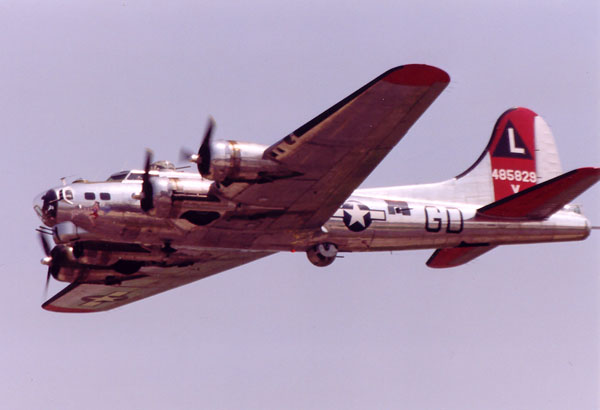
Under the Wing of a B-17G at Boeing Field, June 2008.
The Front put a lot of effort into this comment on the post - also it contains praise for my project, which is yet in the FIMO stage- so I'm reposting it proper with some additional commentary.
"The effect I want in the piece is related to this image - the power, the salvation, the destruction, the intense moral complexity."
Here are some reflections on the perfect formulation quoted above:
1) It was beautiful, especially when contrasted with the insectoid German aircraft. I suggest you depict the B-17G (introduced in January 1944) which was delivered with a natural silver finish.
2) It killed a lot of people.
3) Its killing was neither random nor precise - it discriminated, but only to a limited degree, between people who were keeping the German war machine in high gear and everyone else. It had a great bombsight, the best of its day, yet bombs still landed on churches, schools, and hospitals.
- I wanted to note here that in my limited reading, this is I think true, and much to the credit of the American commanders as opposed the the British. For the early part of the campaign, the commanders and crews tried to avoid civilian targets. But late in the war, as radar became available, as Curtis LeMay gained sway, the Norden bombsight skills were left behind, and by the time the B-29 hit Japan, precision bombing was replaced by mass destruction. Note the points below.
4) The terror was not asymmetrical (this is a critical contrast with the B-29, which slaughtered with impunity). A lot of people died in the B-17, and the crews lived in fear. Gregory Peck explains ("you're already dead") here.
5) It came by day. It was not widely used in night raids. Again, a sharp contrast with the RAF's less-accurate, less-dangerous (to be in) night bombers.
6) As impressive as a single B-17 might be, it was a member of a horde - late in the war, an endless stream of angel-monsters originating over the horizon. The B-17 is best seen not as a discrete entity, any more than a single ant is a discrete entity. Their interlocking defensive fields of fire made them profoundly interdependent, especially in the gory pre-P-51 days.
It is these interlocking fields of fire - the fascinating 3-d geometry of arranging the formations, comparable to line of battle arrangements in the naval wars of sail, that provide much of the aesthetic for what I have in mind. A common loss rate for the B-17 was 6% to 10% per raid at one point , and if one fell out of formation, it was curtains. This is more or less what happened to my uncle's plane.
The Front for Dr X is absolutely right - the B-17 cannot be understood as a single entity any more than a sloop of war during Trafalgar. And 95% of the work of the sculpture, if approved, would be making these formations work in metal wire across a 150 foot span.
As the war went on, the horde got bigger, sort of like a Necromancer's horde in Heroes of Might & Magic. As the Wikipedia article on the 8th Air Force points out: "On 7 April, Eighth Air Force dispatched thirty-two B-17 and B-24 groups and fourteen Mustang groups (the sheer numbers of attacking Allied aircraft were so large in 1945 that they were now counted by the group) to targets in the small area of Germany still controlled by the Nazis..."
Stalin reputedly said: "quantity has a quality all its own."
And nothing the Germans could do, no matter how heroic or insane (and the German operations were often richly imbued with both characteristics), could stop them. From the Wikipedia article:
"The next day [March 3, 1945], the largest formation of German jets ever seen made attacks on Eighth Air Force bomber formations over Dresden and the oil targets at Essen, shooting down a total of three bombers."
7) Some planes are strongly identified with the victory phase of the war (the P-51, the Hellcat), and others are strongly identified with the ugly early years (the Devastator torpedo bomber, the Brewster Buffalo). The B-17 was in service through the entire conflict, and as such participated both in unequivocal victories, and horrific defeats.
8) From the German perspective, the B-17 can be seen as a severe ideological challenge. The Germans spent an inordinate amount of time trying to look scary ("have you looked at our caps recently? ...they have skulls on them..."). They put a siren on the Stuka to scare the people it didn't kill.
(B-17 G Boeing Field, June 2008.)
Very nice, but the B-17 wasn't designed to look scary, it was designed to work. It was really good at carrying a bunch of bombs to an oil refinery and dropping them on it. This was sort of a kneecapping for the "my vision is reality" delusions of the Nazi leadership.
(As I wrote that last sentence I thought of "shock and awe" and "the reality-based community". Hmmm.)
The B-17 made bullshit walk. It was radically materialistic and annihilated ideology. It was a big, shiny, loud, clumsy, deadly fact. And the Germans had no answer for it.
Kudos for the phrase "annihilated ideology." This is the nut of the American form of anti-fascism.
This picture of scrapped B-17s awaiting salvage also seems relevant.
My Dad, stationed as a meterologist in Frankfurt in early 1946, remembered seeing the B-17s lined up like this, for sale at $100 each. People bought them and drained the remaining gas to supply the gray market.
Yesterday a B-17 flew over my head twice, probably this very G-model, in 8th Air Force livery, as I walked by the sea. The B-17 is a talisman in my life - what my father worked to protect from sudden storms that killed the young pilots still in Texas, what my uncle nearly died in as a navigator over Germany, the nexus of my family's experience of WWII. It still permeates Seattle, the strangely appealing and ominous bomber, the machine that made this town a city, an aircraft whose purpose was to place large amounts of high explosive on buildings and people, assembled by women, all to the great glory of life and democracy, I need to believe, and to darker purposes of power and property, I often fear.
It is a symbol of my own safety, family history, beliefs and prosperity, and my own distant, romantic delusions about the nature of war.
But it's a good day to remember several stories: my father catching a ride to Chicago -in all likelyhood to catch a Fats Waller show - in the nose of a B-17, watching the world pass in the best view in the world, falling asleep and waking hours later in a deep fog, with the smokestacks of the city passing high - whoops - above his head.
The image of the B-17s and P-51s parked in rows by the Frankfurt aiport in 1946, all for sale somehow, $100 each or perhaps good cigarettes, men buying them just for the fuel still in the wing tanks. He told me once that he knew a pilot who would pay $100k for any B-17 he could find in 1970, because it was the best platform for aerial photography.
His field in Dalhart, Texas primarily trained B-17 bomber crews. My father had a life-long affection for that plane, and wondered if he could fly one in an emergency. The crews called them ships. They broke, or allowed to be broken, the Nazi war machine. And they burned and destroyed a half million? people. I believe now Curtis LeMay had become sociopathic in his strategic bombing campaign. Yet I am pleased there are still twelve B-17s flying.
A photo shows my father's arm holding the skull of a Japanese soldier burned out of a cave on Saipan a few months earlier. His friends are smiling - it is a post-war moment, so it is a cheerful, almost delirious moment. He was passing through the Pacific island, on a kind of flying hop around tour, an Army Air Force captain, a meterologist working his way by air to the literally smoldering remains of Frankfurt Airport in early 1946. There is nothing but the joy at the death of an enemy, the death that meant peace.
He served most of WWII in the U.S, except a stint around D-Day in England I know almost nothing about, working in some capacity with the forecasters for the invasion. It's not in the documentation I have, but he pointed out that he missed that day when the decision to go or not was made. No point making that part up. Like many men who didn't serve in combat, I think he felt keenly his exclusion from the shared physical risk.
Yet he knew many men who had been so competent, confident and capable in the war who simply wasted away in peace, or that particular peace we built. The consumer peace.
But he sacrificed still, like all families, like families of soldiers and dead civilians victims of war now. His brother, my uncle Duane, was wounded horribly in air combat over Germany with 20mm cannon fire from a Nazi fighter striking his head. The energy of the bullet must have been spent, somehow. It was an archtypical B-17 moment, war in the air, the ship struggling on three and then two engines, metal rattling and brittle cold air pouring through holes shredded in the fuselage, bodies bleeding less in the cold, and yet it landed back in England. The ambulance they called a meat wagon came as Duane was taken out of the plane, and the medics weren't going to take him until the pilot pulled a gun on them, telling them to take him in or he'd blow their heads off. He outlived my father, but paralyzed on one side.
But the sacrifice was in how Duane's spirit was destroyed, how he might have walked again but didn't, how in a falling out over this they spoke only every few years until their deaths in the 1980s. He didn't come to my father's funeral. I didn't go to Duane's. Duane I only met twice as an adult. This story is almost all I know about him, that and when they were kids in Nebraska he had an unfortunate love of onion sandwiches.
I think something about that incident and certainly the military experience drove my father to Alaska, and in a way drove his first son, disconnected from a fairly large family, into the Green Berets in Vietnam. And Grant I do not really know now either. I do know that WWII nearly cured my father of respect for authority and/or wearing hats.
I know more, much more, about the B-17 than these other men in my own family, which the war both ennobled and broke apart through the instrument of the B-17, that beautiful bomber whose elegant, oddly humanistic design seems to have been the final echo of humanity in the military industrial complex that grew to maturity in that war.
But I hadn't thought until yesterday about the man in the German fighter who fired that 20mm cannon round which changed my family in these ways, how, in real war, all battle is equivalent, metal piercing flesh at high velocity, metal emitted from an insane magic bag of ideologies, ever ripping apart human beings. He fired on a man named Bollenbach, which is also a small village in Pflaz-Rheinland. That pilot probably died that day. And the B-17 carried my uncle back to American life, and men waited for its throaty roar, for their friends.
Now at this great remove from that injury, and the ones my uncle and my father inflicted on our nation's enemies - before and since friends-, I am safe and grateful and indulgent in my whims of work and play. But a tiny dark hook of that war that still touches me: what was my father's family? I might have found out, but time had passed, and I did not.
Agnostic as the day is long, I have an answer for the Pope's question at Auschwitz on Thursday: where was God? He was unknowing, stumbling, half-blind and blundering, like he always is, and seeking mostly to stay alive and keep his friends alive; that collected human consciousness we dully call God lived and worked in the Allied soldiers, the undergrounds, the millions paralyzed in fear, the victims of both the Nazis and the God's vengence we visited upon them, in dischordant momentary compassions among the Germans themselves, but most in the sum of all that resisted in every way industrial murder for madness and property.
And this vengence flew too on terrible, beautiful wings.
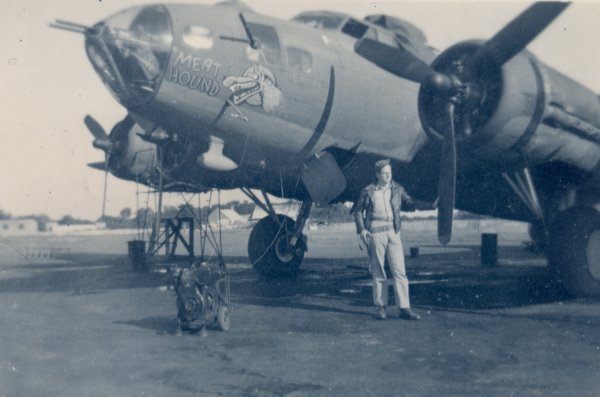
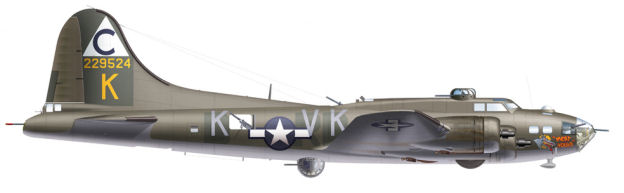
"Meat Hound," In the 306th Bomb Group, before it's transfer to the 303rd. Above is Thurleigh airfield. To the right is the 423rd squadron patch.
24 July 1943. England. USAAF 8th Air Force. Little Blitz Week
306th Bombing Group “The Reich Wreckers”, 423rd Squadron. 167 B-17s are to mass for an attack on an aluminum and light metals plant in Nazi-occupied Norway, at Heroya, an industrial area 70 miles from Oslo. The 306th is the first to attack Germany, and Wilhemshaven, in January, and is equipped with B17e s and fs, learning strategic bombing by doing.
The flight is long, nearly 2000 miles, and the first American bombing force in Norway.
Among the B-17s lifting off from Thurleigh airflield in Bedfordshire is “Wahoo II,” under Captain David Wheeler. The crew commonly uses another bomber, about which a fair amount is known, “Meat Hound,” but with damage and injuries substitutions are common.
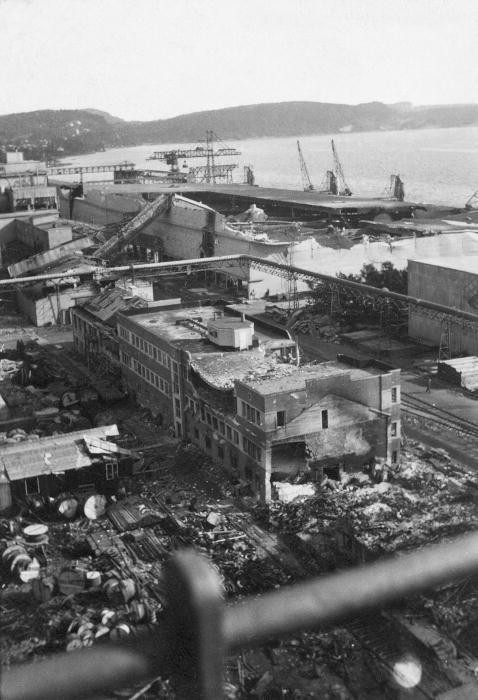
The unfinished target, intended to produce critical light metals like aluminum as well as magnesium, is also close to the Norsk Hydro nitrate works – meaing materials for explosive munitions – a later raid on Norway targets the Norsk Hydro heavy water plant at another location, infamous for its collection of material for controlling a fission reaction. (Bomb damage at Heroya, from this raid.)
The weather is at best marginal for flight operations.
(My father, held a lifetime of anger towards his commander at Dalhart AFB in Texas, for sending B-17s in thunderstorms directly against weather staff’s recommendations, leading inevitably to the avoidable deaths of aircrews.)
The 306th, with 200 men and 20 aircraft, is the second group in the bombing formation, but the lead group loses sight of the target.. The 306th takes the lead, drops its load, and the target is destroyed, never to be rebuilt until after the war. Some aircraft are hit by flak, but the damage is limited. 800 men on the ground are killed. 775 are German. The Norwegians were literally out to lunch. The Norwegian government later sends a note of thanks. An official report described the raid as a great success with “negligible casualities.” By any standard of the moment, that was true.
At 1:52 pm, off the coast of Christiansland, a group of German fighters takes off.
(The following is the account from the book, First Over Germany, by Russell Strong, 1982.)
“Seven planes were damaged, but only 42-5086 (Wahoo II) was seriously hit. As the flight home looked peaceful, Capt. David H. Wheeler got out of the pilot’s seat to check on the gunners. 1st Lt. Donald R. Winters took over the controls. Looking out a waist window, Wheeler saw movements on the ground –German fighters taking off- and as the formation was only at 2000 ft, it did not take long for the enemy to arrive.
“‘I dashed back for the cockpit and arrived in time to see tow ME 109s coming in high,’ says Wheeler, ‘I pulled the nose down and the fighters screamed across the top of the plane, firing as they came.” A 20 mm cannon shell shattered the instrument panel causings losts of smoke in the cockpit; fragments from the same round hit Lt. Duane Bollenbach, the navigator, in the temple. Bollenbach, whose flak helmet was hanging on the bulkhead nearby was in critical condition. Lt. Floyd Evans, bombadier, held Bollenbach’s bleeding head in his arms for the five hours on the way back to Thurleigh.”
“During the melee a fighter came up under the tail of Wheeler’s plane and almost cut the tail gunner’s position open, seriously wounding Sgt. Raymond Norris in the legs. The damage left Norris nearly hanging out of the plane.
“As the group made a turn toward England, Wheeler found that his aileron cables had been shot out and he was unable to turn. Letting down further, Wheeler began manouvering the plane with his engines and, as the fighters were still nearby, he took the aircraft into some cloud cover. Quickly the crew became aware that German planes were still firing at them; then the realized that the clouds were thin, and although the fuselage was concealed, the big Boeing tail was sticking out above providing an ample target for the Luftwaffe.
“Thinking that they might have to ditch at anytime, Wheeler tried everything to keep the plane in the air. The crew got rid of any equipment they could drag to an exit. Despite the severity of wounds to personnel and battle damage to the plane, Wheeler opted for landing at Thurleigh rather than an (RAF) base, if he could make it, feeling that immediate medical attention for his two wounded me was essential.
“As they approached Thurleigh, Wheeler asked Engineer Harvey Noyes, Jr. to crank down one wheel and the flaps. It was then that Noyes informed him that the crank was among the items which had gone into the North Sea. Flying precariously, Wheeler and Winters managed to turn on to runway 24 and began the final let down without flaps, without aileron control and with one wheel only partially extended. They touched down at about 120, roared down the runway and finally ground looped to a halt, missing the plae ahead of them by ten feet. Bollenbach was permanently out of combat, but survived, Norris later was able to complete his tour.”
It was then that my father’s story of this event picked up, the medical team refusing to take in my uncle, who with three large 20 mm cannon fragments in his temple did not look like he was going to survive, and were only persuaded to help when Captain Wheeler pulled his .45 and threatened to kill them. What my father didn’t tell me was the aftermath in the states, and the nature of the estrangement between close brothers: Duane’s spirit was broken. His beautiful wife Jo couldn’t stand to push him through the painful physical therapy, while my father tried to insist that they needed to get tough. Jo, out of love won, and Duane never walked, and I knew my uncle only in fragments of time, seeing him last in Kansas City in 1985.
Although there was an amazing amount of information about the mission, the 306th and related 8th Air Force bomb groups 358th and 303rd, and even the specific plane “the Meat Hound,” I had to go the Boeing archives at the Boeing Flight Museum here in Seattle to find this book. The staff were helpful and handed me a rather amazing B-17 pilot tips manual, which I have to say was clearer and easier to read, and almost shorter, than my Honda Civic manual, things like, what to do if your B-17 catches on fire. It occurred to me right then that the B-17, with 13,000 examples in the middle of WWII, probably had more successful flight time while on fire than any other model of aircraft. "Wahoo II" was fixed and shot down later, as was "Meat Hound." More history of the aircraft is below.
One of the archivists said something about that war that resonated. Even in America, that war touched every family – who went where, what they learned, their economy, their careers, every lifetime was altered somehow. I heard from Lt. Evans’ daughter, who said, understandably, that Floyd had nightmares of my uncle’s injury for many years. Although Floyd became a test pilot, and kept in touch with Duane and Captain Wheeler, he never attended the reunions.
As I wrote before, the B-17, with its morally complex legacy, is a talisman in my family, uniting in purpose and then splitting two brothers who’d been very close. And here I am in Seattle, its birthplace, reading this story literally a block from where “Meat Hound” was built. They have a display of the curiously toy-like wooden air flow test model of the B-17 at the Red Barn at the Museum, a very beautiful object, a strange funnel between the pure ideation of design, and the actual, extraordinary history and impact of the real planes, in endless squadorns and sorties of over 1000 aircraft and 10,000 men in the air, and German cities burning in terror. The B-17 was the plane that really made this city; even as it flattened others, in the terrible, righteous vengence of the Allies.
As it turns out, the only flying B-17f in the world is just finishing restoration here. I’m looking forward to seeing it.
MORE INFORMATION:
Eighth Air Force Mission #75 was a stunning blow to the Axis war machine. In the first bombing raid into Norway 67 heavy bombers made the 1,900-mile round-trip to attack the nitrate works at Heroya. It was the longest bombing mission of the war to date, one totally unexpected by German tacticians, and effectively put the important war plant out of operation for nearly four months. Meanwhile, other bombers of the 309 total force, attacked enemy naval installations at Trondheim, as well as other targets at Bergen. Of the more than 300 bombers launched at the opening of what would become known as Little Blitz Week, only one was lost. Her crew nursed their flak-damaged B-17 o Sweden where they landed without casualties, and were interned. While the Axis reeled from the unprecedented strike that was later described as: "The most successful and shrewdly planned and executed mission of the entire war," General Eaker pressed his advantage. The morning following the attack into Norway he sent 323 heavy bombers across the North Sea to strike inside Germany, attacking the shipyard at Hamburg and submarine base at nearby Kiel. This time German fighter pilots were prepared however, and nineteen American bombers were lost. The trifecta was completed the very next day when 303 heavy bombers were unleashed on the Reich, again attacking at Hamburg with 54 bombers while other's penetrated deeper into enemy territory to strike other targets. Nearly 100 Flying Fortresses fought their way deep into the heart of Germany, the 92nd Bomb Group hitting the Continental Gummiwerke A.G. Wahrenwalderstrasse tire plant at Hanover, just 150 miles west of Berlin. It was a classic test of the as-yet-unproven aerial warfare doctrine: "The well-organized, well-planned, and well-flown air force (bombing) attack will constitute an offensive that cannot be stopped."
The crew of Meat Hound flew with the same unit as the famous Memphis Belle.
The 306th, under Brigadier general Armstrong, was also the direct model for one of the greatest war movies ever, "Twelve O'Clock High," usually regarded by the veterans as the best and most accurate - and the sense of unbearable tension in that movie, combined with psychological stress and destruction, characterizes the 306th's unhappy position as a learning tool.
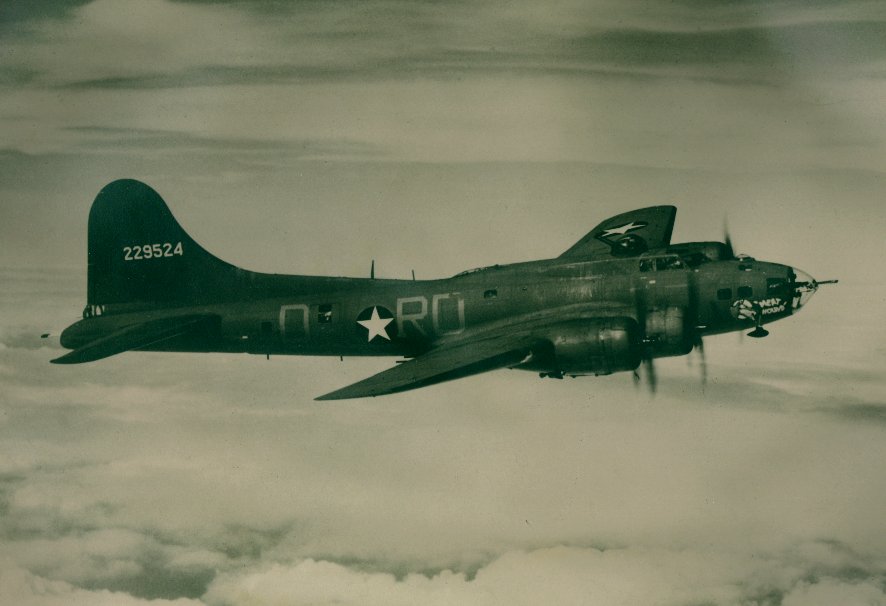
Mission #98 - 11 January 1944 to Oschersleben, Germany in B-17G #42-29524 Meat Hound (358BS) VK-P Was last seen by other crews with two feathered props at 1329 hours on a heading of 270 degrees at 15,000 feet. The crew, with the exception of 2Lt Watson, bailed out over Vsselmeer (formerly Zuider Zee), Holland. Four landed in the water and drowned, 2Lt Clayton David evaded capture and three became POP's. 2Lt J.W. Watson, after his crew had bailed out, decided to attempt to fly his badly damaged B-17 back to England alone. With two engines still ablaze, the left elevator shot off and a shattered connection between one wing section and the fuselage Lt Watson brought his B-17 down through a overcast and crashed his damaged B-17 at the 353rd Fighter Group P-47 airfield at Metfield, England. It took the emergency fire crew over two hours to put out the fires on the B-17.
29524 (423rd BS, 306th BS, "Meat Hound) transferred to 358th BS, 303rd BG. (Shown above in 303rd livery). Shot down by fighters over Durgerdam,
Holland Jan 11, 1944. 3 KIA, 6 POW.MACR 4269 . (USAAF Aircraft Registration records).
I also received an email from a gracious fellow named Alec Kingsmill, who had posted this on a 303rd BG message board:
I am writing up my recollections of WW2, as a schoolboy. My principal interest was in aeroplanes. I have record in a notebook of B-17 42-29524 "Meat Hound." landing at Weston-super-Mare, Somerset either battle damaged or low on fuel. Weston was a relatively minor airport and the B-17 arrival caused quite a stir. A Lancaster used for sea weapon trials had to be moved from its normal spot to facilitate this landing. This is must be among WW2's trivia but I'd be delighted to learn anything about the circumstance of the B-17 arrival, and indeed, of its subsequent fate.
Thurleigh Control Tower, Bedfordshire. VE Day, 1945.

Meat Hound, covered in fire foam, 1944.
After about a year of fleshing out the idea and getting some interest, the WWII B-17 bomber sculpture concept reached a new point with UW lending me a small work/studio in the old metal shop to start building the large model for the sculpture, which will alone require some time to prepare: A nice leap of faith considering I am brand new to working with metal, let alone the elements of engineering.
For those new to this, the sculpture idea is to reproduce a WWII formation of 200-300 Boeing B-17 bombers "flying" four stories up over the somewhat neo-gothic School of Art building courtyard on the main campus at UW. The 3-4" planes will be designed to look they are being seen at altitude and at distance. Elements include using the original complex geometries of the aerial formation, towers which support the structure, sound, shadow and freestanding parts. If eventually approved and built it would be about 135 feet long, held up partly by the interlocking contrails, made of wire, exhausting from each bombers four engines.
It's taken a while to secure the necessary workspace, so in a few weeks its off to the studio to develop the model - I expect a lot of frustration and problems, but I've had a lot of offers of help. This model is the key to the project and I have a fairly clear idea of what I want it to look like, but lots of detailed fiddling remains. It has structural issues somewhat similar to aircraft or bridge design, and I plan to hit up the very UW aeronautical engineering school that helped with the design of the original bombers for ideas.
The project idea was reinforced by a chance meeting with a Czech man named Heinrich in his 70's who remembered his village being attacked in the war. We met because we were both admiring a flying B-17 at the Museum of Flight, its huge radial engines idling as we talked about what happened to him as a 12 year old during the war.
This was near the Czechoslovakian border with Lichtenstein, Germany, in 1944. The target was a munitions plant right over a hill in his village. He remembered two streams of silver bombers, winking in a perfect blue sky, hundreds of them, stretching from horizon to horizon, all headed essentially for him. He remembered the sound, a thundering, huge sound coming from every direction.
Suffering under the Nazi regime, which had murdered members of his family, and being 12, he was excited and cheered the Allied bombers on. He remembered his mother, who had also lost friends to Allied bombing raids, looking up at the vast streams of aircraft, each with 6000 lbs of bombs headed straight for her, looking up and saying:
"The Americans' planes are so much prettier than the Germans'."
When the bombs fell, "they sounded like logs rolling off a truck, again and again."
The effect I want in the piece is related to this image - the power, the salvation, the destruction, the intense moral complexity. And this thin, garrulous, jolly old gentleman provided me with an image of a fascist that I think will last forever: a huge, brutal Gestapo officer had collared him for finding a gallon of gas for the family car. He described watching the crew-cut officer, in the trademark high hat, sucking on a rotten tooth, the horrible smell unforgettable over 65 years.
It was a living metaphor of fascism, the rot inside the bully.
The construction and deployment of these bombers changed the world more than anything else Seattle has done- and the massive destruction and death they unleashed, and which their crews suffered, helped defeat the most evil regime in human history. Odd to think that Seattle, Washington flattened many of the major cities of both Europe and Asia.
It also set up a dangerous habit of technological, militarist solutions to political problems - a point the old Czech fellow, a former missile maker who had lived through Hitler and the Soviets and worked with a few unrepentant former Nazis making missles for the U.S. in Denver, emphasized.
I also learned from Henrich that my own obession with the B-17 was shared - its humanistic beauty as an object was not merely a romantic haze around a brutal war, but perceivable: the B-17 as a pure form is almost feminine in it's extensive, elegant, intersecting curves. It is a ship full of men with a shared, dark and difficult mission. It looks like righteous vengence, which I think, on balance, it was.
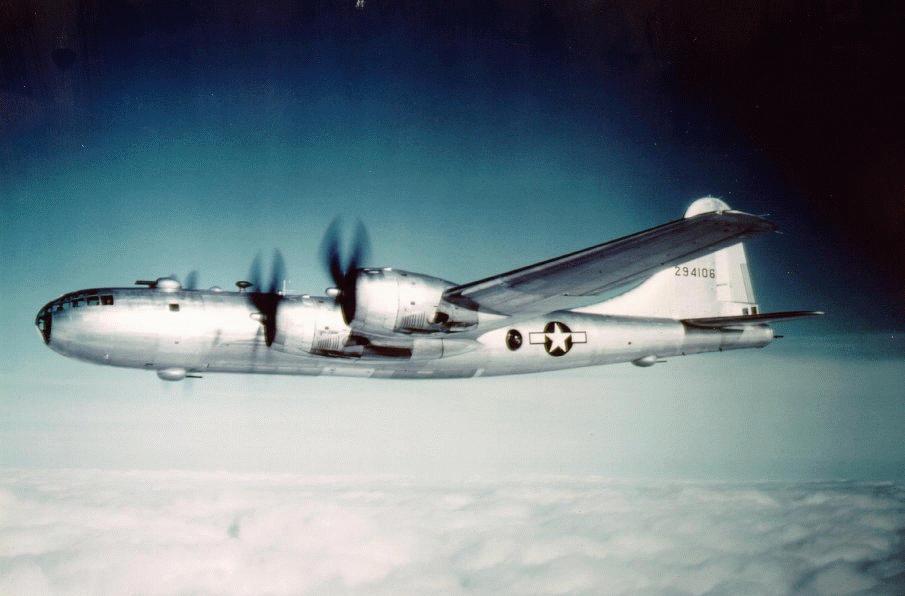
It's technologically brillant follower, the B-29, sleek and seamless, appears like a refined weapon of mass death. Which it was. The B-29 probably killed more human beings than anything else the United States ever produced, a very direct result of Seattle's ingenuity. The strategic bombing campaign of WWII is at once among the best and worst things America has ever done.
A side note: the Frye Art Museum in Seattle was a direct result of the fiery 1943 crash of a B-29 prototype into the Frye meat-packing plant- the resulting settlement and rebuild resulted eventually in the museum. This project might be the cap on the other end of time.
I got this book from Loussac Library, and you bet I read it cover to cover. As far as it was concerned, the B-70 Valkyrie was the baddest thing that every flew, and no two ways about it. It could fly up to space at Mach 3 and blow up whatever needed blowing up, fly away before enemy radar could vector in interceptors.
Eisenhower didn't want it because missiles were cheaper, probably more effective. Kennedy campaigned for it, saying Eisenhower was soft on defense. But,
On 28 March 1961, after $800 million (equivalent to $6.7 billion today) had been spent on the B-70 program, Kennedy canceled the project as "unnecessary and economically unjustifiable" because it "stood little chance of penetrating enemy defenses successfully." Instead, Kennedy recommended "the B-70 program be carried forward essentially to explore the problem of flying at three times the speed of sound with an airframe potentially useful as a bomber."
They built a couple, undoubtedly the most epic anything that ever stood on a runway. It was at Mach 3 before they pulled the chocks away.
One eventually did crash, the other's in a museum now.
The contrast with the B-17 strikes me as significant. Where the B-17 was mass-produced, these were a special edition, two copies only. Where the B-17 attacked in a huge interdependent cloud, these were the aviation equivalent of special forces - hit-and-run specialists with maybe a couple of escorts. The B-17 was beautiful "in its way," the B-70 was a show piece with a spiffy pointy nose and cool black windshield. Obsolete when designed, they built it anyway - possibly for political benefit, possibly as a bargaining chip, possibly in the hopes that some of the technology developed would be useful for something else.
But in my world of car radios with cheap plastic buttons, ugly household appliances, and wood-grain vinyl shelf liners, this thing was The Truth, a pure white instrument for going 2,200 miles per hour for no good reason. There was never anything better.
Wikipedia: North American XB-70 Valkyrie / The "missile problem" - (link)
Once, I remember, we came upon a man-of-war anchored off the coast. There wasn't even a shed there, and she was shelling the bush. It appears the French had one of their wars going on thereabouts. Her ensign dropped limp like a rag; the muzzles of the long six-inch guns stuck out all over the low hull; the greasy, slimy swell swung her up lazily and let her down, swaying her thin masts. In the empty immensity of earth, sky, and water, there she was, incomprehensible, firing into a continent. Pop, would go one of the six-inch guns; a small flame would dart and vanish, a little white smoke would disappear, a tiny projectile would give a feeble screech--and nothing happened. Nothing could happen. There was a touch of insanity in the proceeding, a sense of lugubrious drollery in the sight; and it was not dissipated by somebody on board assuring me earnestly there was a camp of natives--he called them enemies!--hidden out of sight somewhere.
-Joseph Conrad, Heart of Darkness
I was talking with the guy there to repair the cable box; he'd been in the U.S. Navy. Like a lot of us, he was waiting impatiently for the Democratic primary season to settle. His issue was the War- ending this war that has faded from the headlines. His perspective: he'd been studying Vietnam. The only U.S. weapon the Vietcong were truly terrified of was the B-52, he said, the massively huge U.S. bomber, still in service today and piloted sometimes by the children of the original pilots.
We were talking about the Iraq war.
"My father, he says 'bomb them all.' He doesn't know what the hell he's talking about. He doesn't understand the incredible violence of it."
"Metal moving through flesh at high velocity," I offered, as if I knew anything.
Another description: a few weeks ago I was chatting with a guy who was in a memorial organization for the Japanese Internment camps - as it happened he'd been in Vietnam, and had seen the results of high altitude bombing.
"They were so high up, you couldn't seem them - a clear sky." Without warning, everything you saw "just suddenly exploded." There was the concept of strategic bombing in action, a flattening of the enemy, created just after World War I, brought to fruition over Southeast Asia, against the jungle itself.
As you might imagine, working on the B-17 sculpture project, I've been reading a bit about the strategic bombing campaign in Europe.
I met recently with a director at Simpson Center for the Humanities and the Jacob Lawrence Gallery at UW to develop some ideas for related exhibition design, and possibly an academic forum on Seattle history, ethics and technology, and the impact of total war and strategic bombing on Western and Asian culture, the forms of local destruction that bombing created. This is dependent of course on whether the sculpture proposal advances to funding, assembly and installation stages. (Update on that- I'm now have a metal shop to use to build the initial model of the installation, and am about to anxiously try to cram basic soldering.)
Working as a visual artist, I'm freed somewhat from normal academic sobriety. I've been reading for the visual and emotional, poring through available images and short accounts. Images of the aircraft themselves, the bomb damage, short video of combat footage. And sketches - we think of film and photography, but WWII, at the time, was still very much a war described by drawing.
But to us today, this was a war of silver grains, and a nostalgia that becomes more intense as the we Americans look to WWII as a kind of moral guide for our nationalism: when we were strong, unselfish, victorious, reluctant and just. That belief is real, and also somewhat false, noble and incomplete. Wars are not neatly described. What we built and unleashed was vast beyond any individual's actual comprehension.
Below is an iconic version of the B-17 in its slow destruction by a German fighter, footage you have seen a hundred times, but in parts. Normally we watch WWII footage in grainy black and white, in short snippets of exciting film. But if you watch it here in its full length, the glaze of the nostalgic history of inevitable victory melts. The fighter approaches to what might be described as walking distance. The bomber's guns hang limply. Nothing moves but the engines. There is nothing alive left to want to stay alive.
Here are a couple more relevant B-17 videos on YouTube; turn down the sound - the sound tends to lie.
A well-edited sense of a mission; excellent formation shots. Part I, II.
The next I find impossible not to include. Caution: these next are particularly graphic. I include because I am trying to wrap my mind around what actually happened, and images have a necessary power.
Destruction of Guernica in 1937. This is considered to be the modern European beginning of mass targeting of civilians by air forces, and - in no surprise to anyone, it was the fascists who really started it. The Japanese had pioneered it earlier in China.
Among the readings I encountered, there were a couple that were particularly resonant. Antoine De Saint-Exupery, of The Little Prince fame, wrote one of my favorite books on aviation, Wind, Sand and Stars, and I just found another, Flight to Arras, is about a desperate flight through German lines in the days of the defeat of France.
When the body sinks into death, the essence of man is revealed. Man is a knot, a web, a mesh into which relationships are tied. Only those relationships matter. The body is an old crock that nobody will miss. I have never known a man to think of himself when dying. Never.
This interesting work, Bombs, Cities, and Civilizations makes a compelling argument: that the U.S. Army Air Forces in Europe did not generally abandon precision daylight bombing, and that they generally avoided targeting civilians, unlike the RAF. This is a important distinction, somewhat lost today - early on, the U.S. didn't generally try to kill civilians in spite of the massive strategic bombing strategy. This is consistent with several pilot accounts I read, although you can feel as shift in tactics as the war progresses. This was with the B-17 and B-24.
With the new Seattle-built B-29, it was under the direct command and philosophy of Curtis LeMay that the Americans really and fully began to target civilians, particularly Japanese civilians- with incendiaries, adopting the bombing philosophies of the Axis, and of the British, which killed far more people than atomic weapons.
The author also spoke to something that strikes me as essential - the tactics began to be developed to fit the technology. What was possible became the driving force of strategy: such as the adoption of radar guidance; the suggestion was even that the skills of precision bombing were being lost in the B-29s after radar targeting was introduced. Indiscriminate bombing became the dominant path, partly because the technology lead the tactics. The result was massive obliteration..
Thinking with visual emotion, it feels this way in the design of the aircraft - the B-17 is a ship, with a little window and a bump on it's surface for every individual- there is something valiant and humanistic in it's appearance. It's successor, the B-29 is an aluminum ice-pick, sleek, advanced, a killing tool. By the time of the B-47, the human being looked incidental.
Does it matter? No. And yes.
Thinking of all this, George McGovern, also a B-24 pilot in WWII had the most persuasive take: what we did was truly terrible, but Hitler was such a monster, it had to be done. In reading the accounts, looking at the photos, it seems like a mass-scale industrial killing, at an incredible sacrifice. 88,000 young Americans died just in the air war in WWII. And we killed many, many more. It was also a cost to our self-concept as a just nation.
To this day this is an aspect of war in America- the moral burden that we place on young soliders, that we seem unable to confront as a nation. We assume- partly from the real justice of our victory in WWII - that we are the good guys, so that is not an important issue. Of course, it is. And one we are failing, as the blame for Abu Ghraib focused absurdly and cruelly on corporals and sergeants.
Strategic bombing was a factor in winning World War II, and maybe an unavoidable one. It was total war and it had to be, if the future was to have anything other than industrial scale genocide-presumably ongoing until the enemies and victims of Hitler, Mussolini and Tojo were exhausted. When would that have been?
But I think we underestimated the cost to the future of opening the genie of annihilation as acceptable strategy. The Italian fascist general Duohet was influential in its development. He foresaw and advocated total war through strategic bombing as desirable and necessary. Billy Mitchell met him once after World War I, (when German dirigibles, amazingly, killed over 1000 British citizens through bombing. ) Our love of the airplane - and by larger extension, of technology, must be questioned, and decisions made consciously. We cannot cede our decision-making to the wonders of technological possibility, which in the United States has become the defacto approach to war.
Rumsfeld's faith in technologically-driven tactics is a factor in our disaster in Iraq. The chain of the logic of strategic bombing eventually lead to Curtis LeMay screaming at Kennedy to launch a first strike attack on Russia with his waves of fueled and armed B-47s sitting on the tarmac. It lead to that bizzare improvement in the Cold War- Mutually-Assured Destruction. And it led to another strange faith in technology to solve a tactical problem: obliterate the jungle using B-52s.
And this is where the guy there to fix the cable, the Navy vet, spoke the name of Curtis LeMay. It was not flattering. LeMay seems to have become a man indifferent to mass death through exposure.
At the end of the second world war, I was the director for overall effects of the United States strategic bombing survey - Usbus, as it was known. I led a large professional economic staff in assessment of the industrial and military effects of the bombing of Germany. The strategic bombing of German industry, transportation and cities, was gravely disappointing. Attacks on factories that made such seemingly crucial components as ball bearings, and even attacks on aircraft plants, were sadly useless. With plant and machinery relocation and more determined management, fighter aircraft production actually increased in early 1944 after major bombing. In the cities, the random cruelty and death inflicted from the sky had no appreciable effect on war production or the war.
These findings were vigorously resisted by the Allied armed services - especially, needless to say, the air command, even though they were the work of the most capable scholars and were supported by German industry officials and impeccable German statistics, as well as by the director of German arms production, Albert Speer. All our conclusions were cast aside. The air command's public and academic allies united to arrest my appointment to a Harvard professorship and succeeded in doing so for a year....
But this is incidental to his musings on contemporary war and political influence, rather than rehashing the bombing debate.
In a more comprehensive defense of the strategy, it was a conscious strategy by people like Jimmy Doolittle to use the bombers essentially as bait to draw out the Luftwaffe and destroy it. Bait - all those bombers, all those bombs, all those airmen, all those civilians and workers. This succeeded- and in an of itself, as horrifying a concept as it sounds, almost certainly speeded the defeat of Nazi Germany.
But you can ask innumerable questions. Why did we not send a raid to target the railroads leading to Auschwitz? That the Allied victory finally ended the slaughter does not I think, exculpate this failing. And you should ask many more, but at some point you end up escaping from the present. And that is another failing. Galbraith's essay above bears on the present war, not WWII.
The war strategy that saved the world from fascism hangs over us now. We are inspired by the technology, by its accomplishment, intelligence and beautiful form, but that is a primrose path. As one WWII pilot put it memorably: there was only one possible excuse for the destruction: Justice. That the justice of the result, the justice of peace, democracy, and the rule of law, was superior to the injustice of a massive rain of death from the sky.
Yesterday, I was kayaking out in Lake Union. Overhead there was a huge rumble of radial engines, not unusual here, with a lake full of old floatplanes. But there was a strange depth to the roar, and I glanced up: a real B-17 roared by at low altitude, flying east in its graceful way, the sun glinting on the unmistakable top turret, the big bomber flickering between black and silver as it turned against the sky.
And then a new sound gradually droned into our ears. The sound was a deep, and all encompassing, with no notes in it- just a gigantic faraway surge of doom- the heavies! They came from directly behind us, and a t first they were mere dots in the sky. You could see clots of them against the far heavens, too tiny to count them individually...They came on with a terrible slowness....in constant procession, and I thought it would never end. What the Germans must have thought is beyond comprehension. Their march across the sky was slow and steady. I've never known a storm, or a machine, or any resolve of Man, that had about it the aura of such relentlessness. You have the feeling that even if God appeared beseechingly before them in the sky, with palms up to persuade them back, they would not have had within them the power to turn from their irresistible course (.) The Germans began to shoot heavy, high ack-ack. Great puffs of it, by the score spackled the sky until it was hard to distinguish the smoke puffs from the planes. The formation never varies, but moves on as if nothing had happened. Nothing deviates them. They stalk on slowly, with the dreadful pall of sound, as though they were seeing only something at a great distance and nothing in between. -Ernie Pyle, Scripps-Howard Correspondent.
I recently interviewed a great old fellow who piloted a B-24 during the war. We talked for about four hours, a cheerful, smart guy in his mid-80s, who is in great health, has been married happily since 1947, walks 4 miles a day, and served 12 years in the Peace Corps.
Because I am an artist and a natural egotist, we were eventually talking about the B-17 sculpture. I feel a little bad about this because the debate over the overall best bomber of WWII between the robust, beautiful B-17 and the specs-superior B-24 has never been settled, and here I am proposing a massive sculpture celebrating the B-17 to a man who piloted a B-24 through 25 full missions.
Ah well. We were talking about his experience of it all, and I asked him about what I might put on the ground below the formation. He thought a moment, and told me this story:
It is very late in the war, and they receive unusual orders for a very, very low level mission: 2000 feet. For the B-24, another big 4 engine high-altitude bomber, this is like sending the Space Shuttle on the commuter run to Cincinnati.
They were to destroy a railroad switching yard, where the locomotives are turned around. He was leading about a dozen B-24s to Germany to destroy this target. There was cloud cover; the flight, many thousands of pounds of explosives, hundreds of men, all headed for one initial point.
They came through some cloud cover, rail tracks, rolling farmland. Unlike every other mission, he could really make out individual houses.
One of which was a farmhouse, one near the rail feature, one that was the exact point upon which they were to release their weapons. He was sixty seconds away.
It was just a farmhouse. He could remember the haystacks. He could remember thinking that inside this house was a farmer, like many he had known back in Wyoming, that the buildings were a little different but the same in function, that in that house was a man who knew nothing of a major force of American bombers coming right for him.
He told me that it occurred to him that he could veer off, cancel the attack; this would have, in effect, spared a single house from total annihilation.
That he had sixty seconds to consider this, that he for a moment held this specific choice, and that he reflected in spite of a foregone conclusion, speaks I think to the best of a soldier's instinct. I reflect now that the truth was this: he had never had to really see an individual person he was assigned to destroy, and now he did, and it was in his power to avert this annihilation, and he, of course, chose the mission.
The mission was to destroy that place. The holy rage of the Allies against the Nazis manifested itself now in a hundred screaming engines, a rainfall of high explosives, rage, technology, speed and metal and death visited upon a man sitting in his farmhouse. Aluminum literally shocked from the good earth, reborn in incredible effort to a flying bomb, massed, directed against a single house, a single man. Dropped within the choice of a man.
He told me that this was the one moment when the scale of what they were doing, the distance between humanity- a real person on the ground- and the war and the mission, became clear.
I've heard this theme before. This is war fever both amplified and distanced by technology. It grew to absurdity in the U.S. Civil War, and ballooned in escalating war logic ever since. That life remains stronger than war amazes me.
Interestingly, Sen. George McGovern was also a B-24 pilot (note his comments on the failure to bomb Auschwitz.) He had a similar incident, but with the luxury of redemption.
Screw You, Colonel - A M*A*S*H* moment in Dalhart, Texas, 1943
B-17s in winter conditions in England in 1945
I was amazed to find a description on the internet of a story my Dad used to tell me from the war, about an asshole of a base commander who tried to order his B-17 trainees into the air in heavy icing conditions, Capt. Burt Bollenbach of course being the weather officer, trained in a highly compressed intense graduate program in the Univ. of Chicago's second meteorlogy class in 1941-42, only to find himself assigned to Texas.
This account completely confirms the story I remember. My Dad was angry 4 decades later about it, knowing more than anyone how much danger the crews were being uselessly put in; Dad pleaded the science, but the Colonel simply would not listen to him- nonetheless, the Colonel's bullheadedness caused something of a blue flu mutiny, with a hilarious punchline, described below by CB "Red' Harper of the B-17 Buffalo Gal.
"We flew as much as weather would allow since it was winter and
we had a lot of snow. One morning after the alarm clock had assassinated
my sleep at 03:00 hours, I shaved and dressed at the tourist court
we called home and was ready to pick up the other two pilots I
shared cars with for the 60 mile trip to the base. I tried to
open the door but it wouldn’t budge. I attempted to look out the
window and only saw snow. We were buried all the way up to the
roof with blowing snow drifts. We were thankful for steam heat.
I went back to bed and it was two days before thawing out enough
to get outside. We finally managed to slip and slide down the
icy highway and get back to Dalhart. When we arrived, we were
told briefing would be in half an hour. I couldn’t believe what
I was hearing. There was at least six inches of ice on the runways.
All the crews had to pass by the flight surgeon’s desk before
each flight. If there were any physical problems that was the
time to tell the Doc about it. I started coughing and gagging
when I got to his desk. He grinned and marked the crew unfit for
flying today. Each pilot had done the same so all crews were grounded
for the day.
"When word got to the commander he threw a wall-eyed fit. He announced
on the PA system that all pilots and their crews would assemble
in the briefing room on the double. He proceeded to rant and rave
before the 300 grounded birdmen assembled in front of him using
endearing terms like “yellow-bellied” and a lot of carrying on
like that. Finally he announced that he was going to put a B-17
in the air and we were all going to stand out by the runway and
watch and freeze our asses off until he got back.
The colonel ordered his executive officer to fly copilot and he
finally got to the runway for take off. The taxi strip was so
slick he couldn’t run the engines up. He turned onto the runway
and moved about 50 feet before loosing control of the beast. He
did a 360 degree ground loop - winding up in a snow bank. They
sent a 6 X 6 truck after him and he had to crawl out the pilot’s
window to get out. As the truck came by with our over zealous
CO in it, all 300 of us came to attention and saluted him.
"That episode was the main course of conversation on the base for
days after."
Surplused B-17s in Ontario, California, just after WWII
The field looks like about 2000 aircraft, which is remarkable, as they built about 13,000, and 5000 were lost in operations.
There seductive appeal of form of the B-17, like the Vargas girls painted on the sides of so many, speaks to other things; it flies in our imaginations like the Spitfire and the Mustang, beautiful aircraft that seemed in their aesthetics to represent the best version of the anti-fascist cause. But it is never to be forgotten that in the course of stopping an unimaginably greater horror, as it faded from history, the B-17 took with it hundreds of thousands of souls. As one B-17 pilot put it, on the day orders shifted from military to
civilian targets, "It was worth it if we accomplished Justice.
Otherwise, it was just mass murder."
War confuses us horribly: by the charismatic beauty of weapons and
weapons systems, by its prizefighter excitement, by how statistics and
abstractions and ideologies are reveled in to the point in which the
humanity of everyone involved is all but erased. War nostalgia must be handled with terrific caution, for it can over-bait the imaginations of men, and it can normalize war-making, tangling our identities up in vengeance over ghosts, and conjuring a fresh hell where none exists.
The whole point of the B-17, not as a pretty plane, but as a weapons system, was to bring the world to this point, in 1946, with a couple thousand aircraft slowly weathering in an open valley, most beautiful on the cusp of their disintegration, with no reason to fly.

 Under the Wing of a B-17G at Boeing Field, June 2008.
 (B-17 G Boeing Field, June 2008.)